



Forests and pollinators

Nature conservation measures at three locations in Sweden

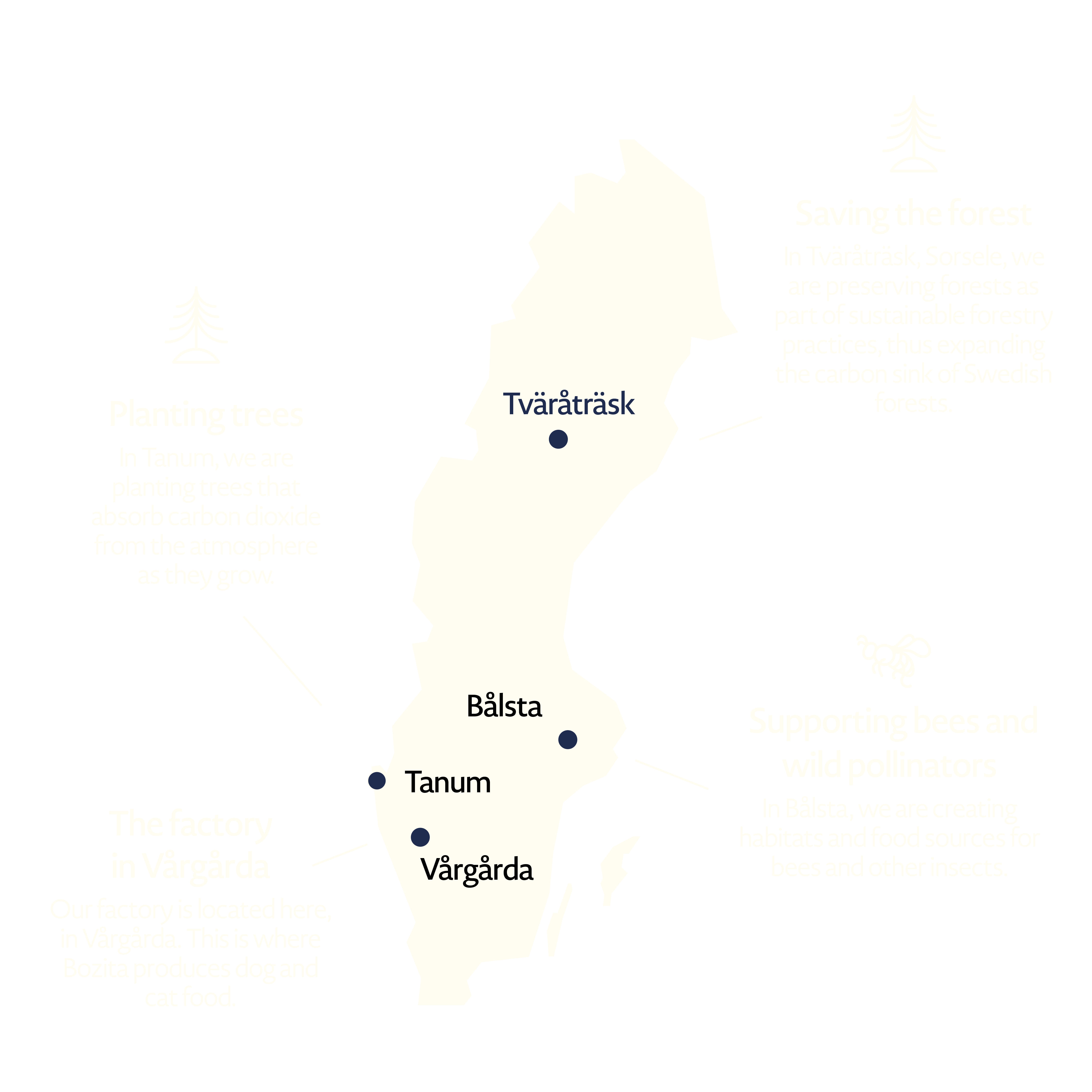
“Forests and Pollinators” is a project being carried out by Partner in Pet Food Nordics AB—the company behind Bozita—in collaboration with Initiativ 1415. The project involves tree planting in Tanum, forest conservation in Tväråträsk, and measures to support wild pollinators in Bålsta.

On this page, we describe the measures implemented, the observations made during follow-ups, and what remains to be monitored over time.

A project on our home turf

Bozita’s production facility is located in Vårgårda, Sweden. The project sites are situated in Sweden, and their proximity allows our employees to visit the locations and monitor how the environments evolve over time. We therefore describe both what has been established and what requires further supplementation.

The project results are valid specifically to the sites in question and should not be interpreted as a statement regarding the environmental impact of Bozita’s products or the overall operations of Partner in Pet Food Nordics AB.

Tree planting and forest conservation

The project involves planting approximately 6,000 trees in Tanum and conserving forest in Tväråträsk, Sweden. Trees absorb carbon dioxide as they grow, but the actual amount varies depending on factors such as tree species, growth rate, survival, soil conditions, and the time period.

Based on the project’s calculation data, the initiatives are estimated to correspond to approximately 600 tonnes of CO2e in carbon sequestration, given the period and assumptions specified in the data. The calculation is a projection, not a result that has already been achieved.

Why are we doing this?

At Bozita, we love the Swedish forest. It is not only a wonderful place for you, your dog, and your cat, but also an important carbon sink. Trees absorb carbon dioxide as they grow, and the more they grow, the more carbon dioxide they absorb. Planting more trees and preserving forests can therefore help combat climate change by sequestering carbon. Furthermore, Swedish forests are home to a wide variety of plants and animals; planting trees can help create new habitats for endangered species and boost biodiversity.
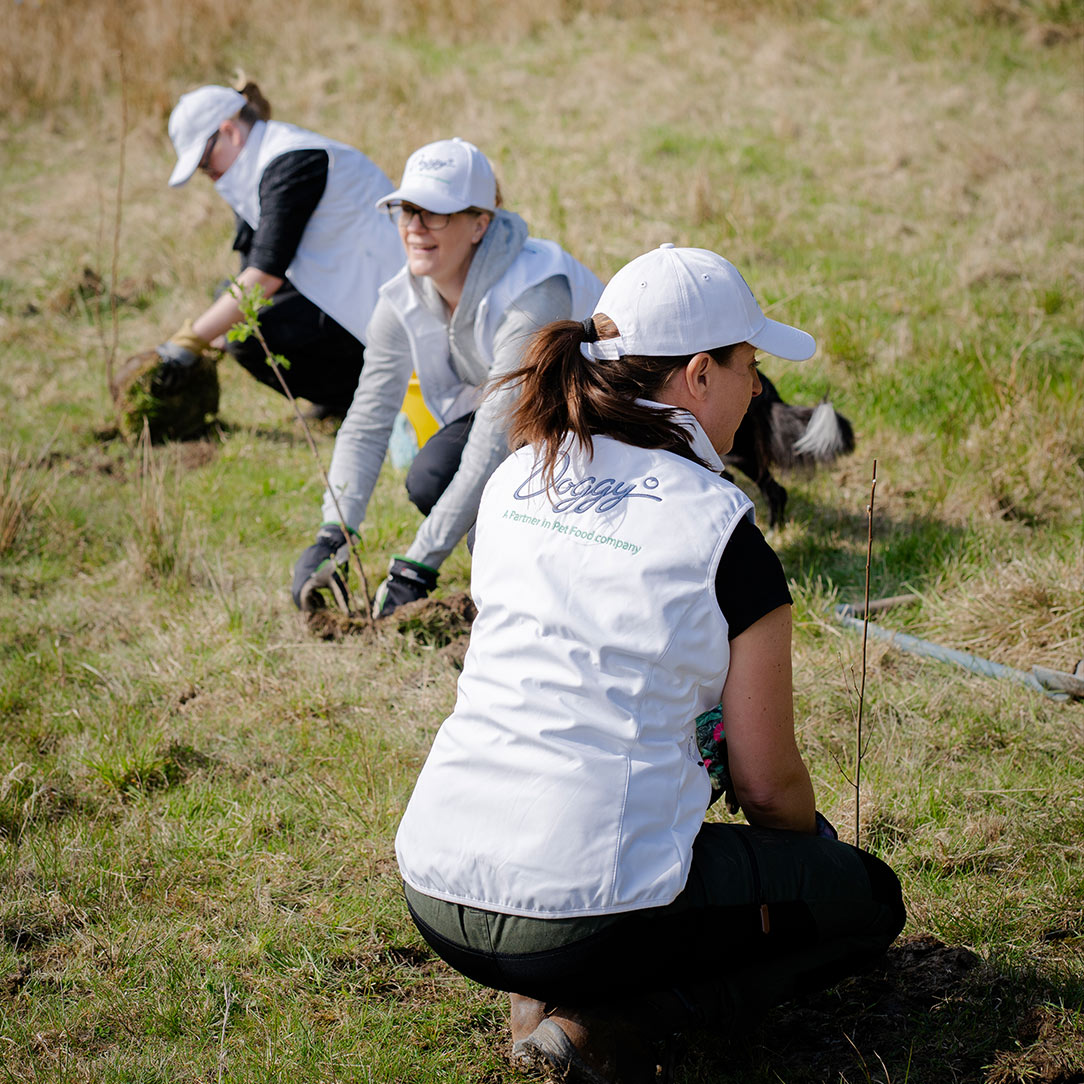

Colleges from Doggy AB planting trees

Did you know…?

  • Trees absorb carbon dioxide as they grow. Just how much depends on the type of tree and where in the country it is growing. One rule of thumb is that a full-grown, 80-year-old fir tree has stored 1.6 tonnes of carbon dioxide. An average Christmas tree has absorbed about 10 kg of carbon dioxide.
  • A variety of trees benefits the forest. For example, mixed forests containing deciduous and coniferous trees are more resistant to insect attacks and extreme weather, such as storms and forest fires. They are also more pleasant for pet owners to visit with our dogs and cats.
  • The more biodiversity, the better for the brain! A walk in the woods in an area with a wide variety of different plant and animal species offers mental stimulation for you and for your dog or cat.

Measures for wild pollinators

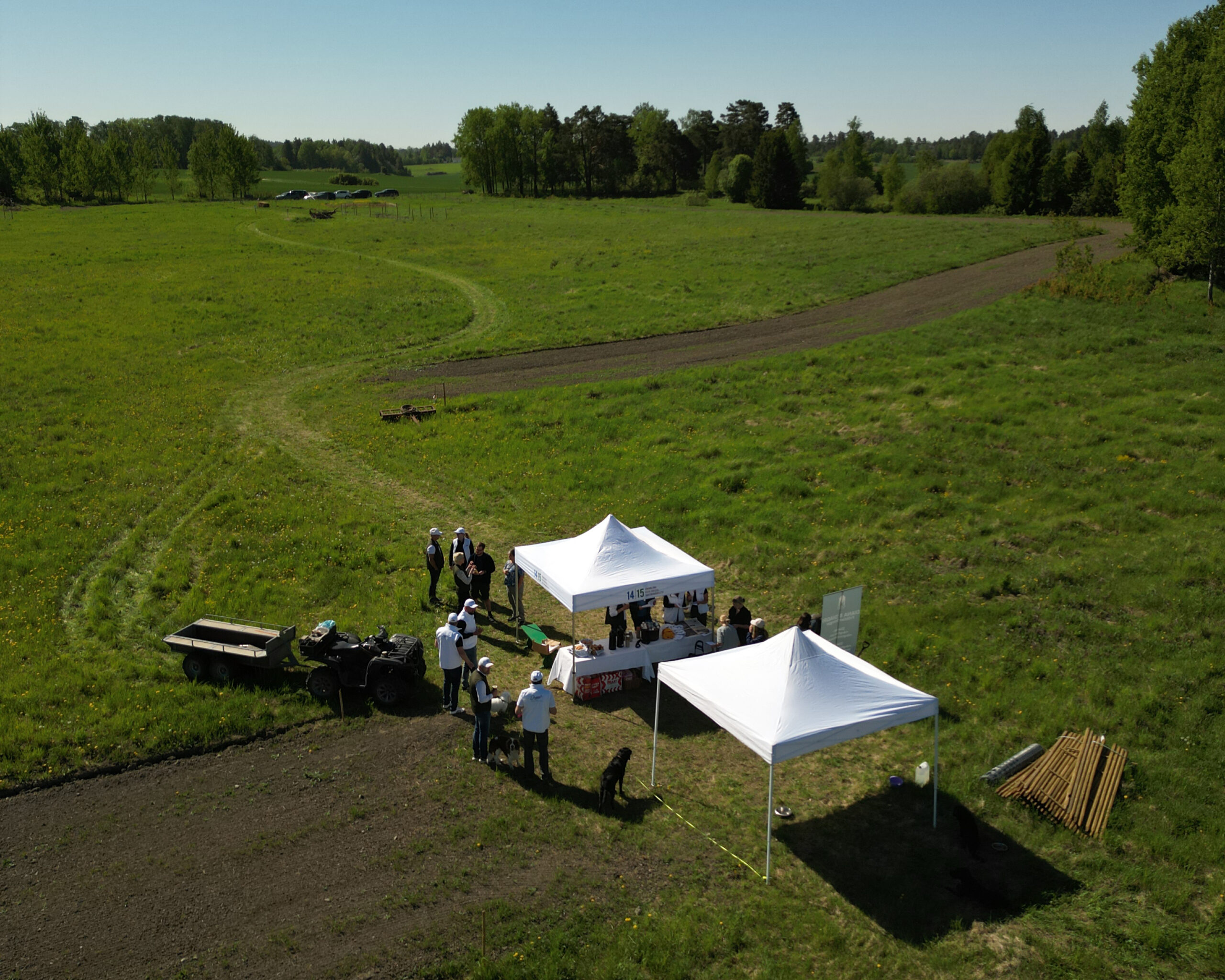
In Bålsta, the project has implemented measures designed to create food sources, nesting sites, and varied habitats for pollinating insects and other species.

The measures are based on recommendations from the Swedish Environmental Protection Agency, Swedish Board of Agriculture and the County Administrative Boards of Sweden, and the results are being followed up over a ten-year period.

For biodiversity, we have:

  • Planted selected varieties of trees and shrubs, such as oak, willow, rowan, white oak and hawthorn, guelder rose and blackberry – species that offer high biodiversity values.
  • Sown wild meadows to produce pollen and nectar. Attracting many different kinds of pollinators requires a wide variety of flowers, preferably of different varieties so that something is in bloom throughout the season. We use Malmgård Viltfrö’s bee field mix with species that bloom from June to September.
  • Placed out two bales of straw, where bees and other insects can build nests.
  • Laid out two 10-tonne sand beds, where bees and other insects can build nests.
  • Created two fauna depots with a blend of tree stumps, branches and twigs – dead wood that is essential for food and habitats for many plants, fungi, and animals.
  • Exposed rocks to create warm surfaces for bees to enjoy.
  • Established a traditional hay meadow.
  • Established a mini wetland.
  • Created a beetle bank.

Why are we doing this?

Bees and other wild pollinators contribute to functioning ecosystems and our food supply. Upwards of 75% of all crops depend fully or in part on pollination from insects. But the situation for wild pollinators is dire, and here in Sweden, one third of our bee species are threatened. Therefore, as Sweden’s biggest pet food producer, we cannot only focus on lowering our emissions and reducing our climate footprint – we must also take responsibility for promoting wild pollinators and preserving biodiversity.

The project results are valid specifically to the sites in question and should not be interpreted as a statement regarding the environmental impact of Bozita’s products or the overall operations of Partner in Pet Food Nordics AB.

Bzz, bzz, bzz

A project with multiple positive impacts

Bozita compass
Carbon sequestration

Trees absorb carbon dioxide as they grow, which reduces total carbon in the atmosphere and global warming.

Biodiversity

The measures will help to preserve and enhance the habitats for bees and other wild pollinators, which benefits biodiversity.

Health and well-being

Nature has a positive impact on health and well-being for animals as well as for us.

Local impact

By focusing on domestic initiatives, we are taking part in the preservation and care of nature in Sweden. Proximity to the projects also offers us even better insight and transparency with regard to the work, making it easier for us to ensure a direct and measurable effect.

Bozita compass
Carbon sequestration

Trees absorb carbon dioxide as they grow, which reduces total carbon in the atmosphere and global warming.

Biodiversity

The measures will help to preserve and enhance the habitats for bees and other wild pollinators, which benefits biodiversity.

Health and well-being

Nature has a positive impact on health and well-being for animals as well as for us.

Local impact

By focusing on domestic initiatives, we are taking part in the preservation and care of nature in Sweden. Proximity to the projects also offers us even better insight and transparency with regard to the work, making it easier for us to ensure a direct and measurable effect.

Did you know…?

  • Wild pollinators are important to food production. Upwards of 75% of all crops depend fully or in part on pollination from insects.
  • Many little superheroes offer a helping hand. Among Sweden’s pollinating insects, bees and bumblebees do most of the heavy lifting, but butterflies, flower flies and some beetles also help out.
  • Sweden is home to about 270 bee species. Some are fairly picky and many have favourite flowers. For example, different varieties might have different tongue and proboscis lengths, which means some find it easier to visit deep and funnel-shaped flowers, while others prefer shallow, wide flowers.

Everyone can make a difference!

The more people on board, the greater the difference we can make.

Dog or cat owners – here’s what you can do

No one can do everything, but everyone can do something. Here are a few tips for how you can contribute:

  • Learn about the issue – when you understand how biodiversity impacts us and our furry friends, you will be more motivated to take action.
  • Outdoor cats are skilled hunters and can harm or kill rodents, birds and lizards, which has a negative impact on biodiversity. As a cat owner, you can do your best to prevent this by putting a bell on your cat’s collar, or not letting your cat go outside at night.
  • Picking up after your dog is important for the environment! Dog waste in nature can lead to overfertilisation, resulting in an imbalance in the system that can reduce biodiversity in the long run.
  • Transform a bit of lawn at home by planting clover or a wild meadow. (Make sure to buy a seed blend suitable for your region so that you do not spread invasive species, which can worsen the problem.)
  • Support politicians and suggested policies that promote biodiversity.
  • Support nature and environmental organisations that work with the issue, such as the Swedish Society for Nature Conservation, WWF or Naturarvet.


About the project

Partner in Pet Food Nordics AB, of which Bozita is a part, is currently carrying out an ambitious project with a focus on carbon sequestration and biodiversity.

The project is being carried out together with the Swedish company Initiativ 1415 and is a concrete and local example of how we are actively working to increase carbon sequestration in the Swedish forest, promote biodiversity, and preserve and strengthen habitats for wild pollinators in Swedish farmland.

Do you want to know more?
Read more about the project and how it connects to our group-wide sustainability initiatives at ppfnordics.com.